


Custom software for UK businesses

Systems for the work your existing tools no longer cover

Web Works Rise builds bespoke software for UK businesses whose day-to-day work has outgrown spreadsheets, inboxes and tools that do not talk to each other. The software follows the task: a quote, a booking, a call list, a visit, or a dashboard the team actually opens.

A website can explain the offer and take an enquiry. Software is the system behind that enquiry, or an internal tool the customer never sees. The two are often built together, but they are scoped as separate pieces of work.

The public site that sits in front of a system is covered by web development.

Quoting and booking tools for coach, minibus and chauffeur operators are described on our page about transport booking systems.

How the Birmingham team and the Tunisia hub deliver a project together is explained on our page about nearshore development.

Operations manager working through printed spreadsheets and sticky notes at a desk

When custom software is worth considering

The same details are typed twice. Customer information, prices or job notes live in more than one place, and the copies drift apart.

The working day is an inbox. Enquiries, follow-ups and visits are tracked in email and spreadsheets, so it is hard to see what is due today.

An off-the-shelf product works against the process. The tool comes close, but the team keeps a workaround going because the product cannot match how the work is actually done.

A quote still waits on a person. The price depends on choices the customer can already make, but the site can only send a message and wait for a manual reply.

Developers and a client reviewing a custom business dashboard with tables and a calendar

What software development includes

A first version should be smaller than the pile of spreadsheets it replaces. These are the kinds of systems the team builds.

Quoting and booking. A price that responds to the customer's choices, with payment and confirmation when the job requires them. Coach Hire Network is the published example.

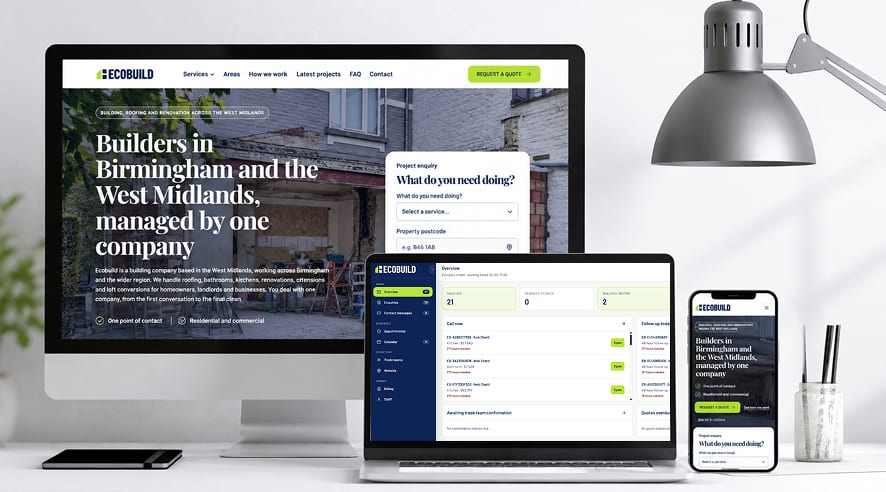
Internal workspaces. A screen for the people who run the day: what to call, what to follow up, which visits are booked, and which quotes are late. Ecobuild is the published example.

Dashboards. One view of the work in progress, so the team is not assembling the same status report by hand.

Connections to other systems. An API or an integration where the new tool has to exchange data with something the business already uses. The connection is scoped to that need.

Screens for non-technical staff. Admin and editing screens the team can use without asking a developer for every ordinary change.

How a software project runs

The first release is the smallest version that removes a real bottleneck.

01 The task

What a finished job looks like for the person who does it, and which tools they touch today.

02 A first version

The steps that have to be in the first release, and the steps that can wait.

03 Screens

The interface is designed with the people who will use it, then built.

04 Build and connect

The system is developed in Next.js and Node.js, and connected to the other tools the task requires.

05 Test it on real work

The team runs real scenarios before launch, then shows the people who will use the system how it works.

Technologies

Software projects are built with the same web stack, plus the infrastructure the system needs.

Next.js and React
The interface for both customer-facing flows and internal screens.
Node.js
The server-side logic: quotes, queues, permissions and the rules of the workflow.
AWS
Hosting and infrastructure when the system should run on Amazon Web Services.

Describe the task, not the software

Tell us what people do today, where the information gets stuck, and what a finished task looks like. That is enough to say whether a custom build is the right next step.

Book a Free Consultation

Relevant work

Both projects also have a public website. The notes below are about the operational software, not the marketing pages.

Ecobuild coordinator workspace, shown in the case study

Ecobuild coordinator workspace

Ecobuild coordinates building work across the West Midlands. The public site takes a short enquiry. The coordinator workspace then shows calls due, follow-ups, visits and overdue quotations. Each enquiry keeps the questions that have to be answered before it is treated as qualified. Delivery-team contact details stay inside the workspace, and selected homepage cards can be edited there with a preview.

View this project

Coach Hire Network website, shown in the case study

Coach Hire Network quote and booking system

Coach Hire Network's public site was rebuilt in Next.js. Behind the quote form, the price responds to the customer's selections, payment can be taken online, and the booking can be confirmed without waiting for a manual reply. That quoting and booking flow is the software delivered on this project.

View this project

Why Web Works Rise

The same UK-led team handles the public site and the system behind it, with delivery from the development hub in Tunisia. You do not have to brief a separate web agency and a separate software supplier for one connected project.

The build starts from the workflow. If a product you already own can handle the task, we will tell you so in the first conversation.

Frequently asked questions

How is this different from a website?

A website explains the business and gives visitors a way to enquire. Software is the system that carries the work after that, or a tool staff use internally. A project can include both. They are specified separately so the public pages are not asked to do the job of an operations system.

Can you connect it to tools we already use?

Yes, where the project needs that connection. The published examples are a quote that calculates a price and takes payment, and an enquiry workspace that keeps calls, visits and team details together. Any further integration is scoped to the system you already have.

When is a custom build a poor fit?

When a product you already pay for can run the workflow with a sensible setup. Custom software is for the point where that product, or a spreadsheet, is creating duplicate work or blocking a step you cannot remove.

What happens after launch?

The team can stay in contact and make later changes. Ongoing updates are described on the maintenance and support page. Larger new workflows are scoped as further development.

Talk to the team

Tell us what you need, what you have today, and what a good result looks like. We will reply with a practical next step.

Book a Free Consultation