


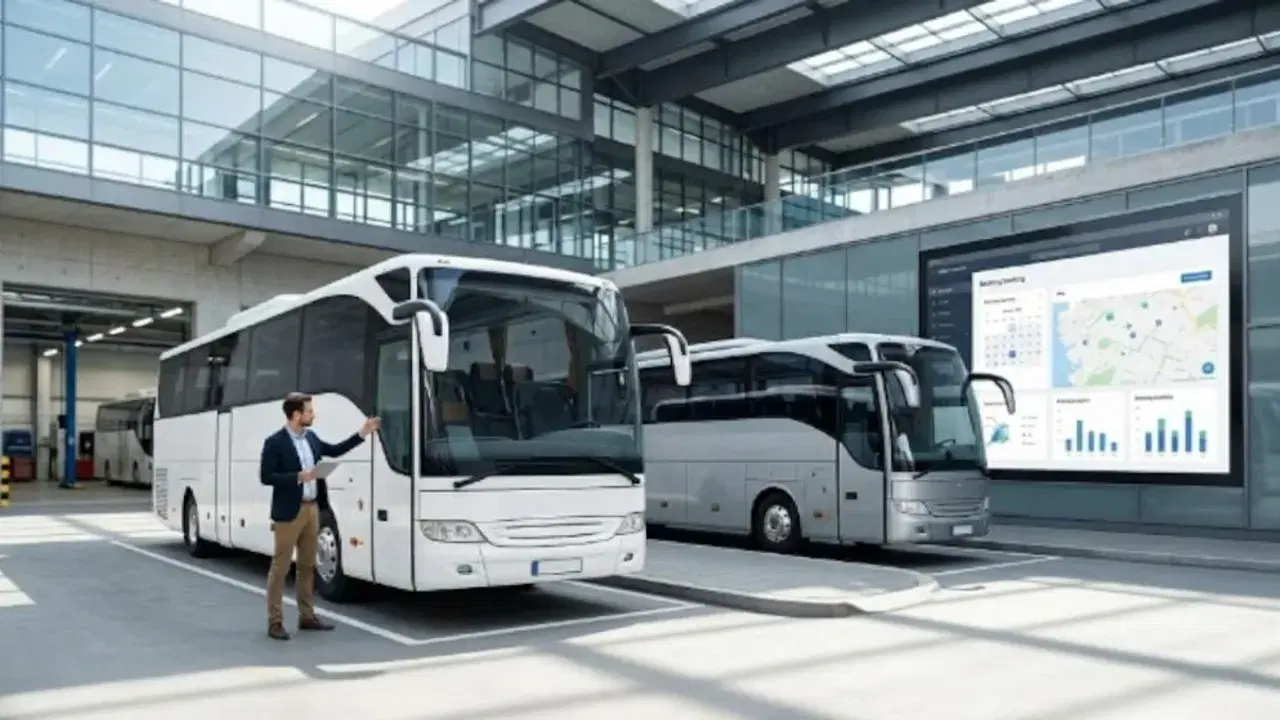
Someone organising a school trip, a wedding or a team away day rarely books the first coach company they find. They open three or four sites on a phone, often in the evening, and look for the same things: does this operator have a vehicle that fits the group, can they be trusted with it, and how quickly can I get a price? The site that answers those questions first usually gets the enquiry.
This guide draws on transport projects Web Works Rise has delivered, including the Bouden Coach Travel rebuild and the Coach Hire Network platform. It covers what a coach hire website should show, in what order, and where the quote journey usually breaks.
Lead with vehicles, coverage and the quote
The first screen has three jobs. Show the kind of vehicles you run, say where you operate, and offer one obvious way to ask for a price. A phone number alone is not enough, because many people research outside office hours and would rather leave their details than call the next morning.
Below that, the homepage can introduce the main services: school transport, corporate travel, airport transfers, weddings and events, day trips and tours. Each one should link to a page that explains it properly. A long homepage that tries to cover every service in a paragraph each tends to answer none of them well.
Give each vehicle and service its own page
People search for the job and the vehicle together: "16 seater minibus hire", "coach hire for a school trip", "executive car to Birmingham Airport". A single fleet page with a gallery cannot rank for all of those, and it rarely answers the questions behind them.
A good vehicle page shows the capacity, luggage space, on-board features and the trips it suits, with real photographs of the interior and exterior. A good service page explains what is included for that type of customer, for example the safeguarding questions a school will ask or the timing a wedding party needs. Both should end with a quote button that carries the choice through, so the customer does not have to pick the vehicle again on the form.
On the Bouden Coach Travel project, the content was restructured around the services that bring in enquiries: coach hire, minibus hire, chauffeur travel, school transport, corporate travel and airport transfers. Coach Hire Network went further, with pages for journey types, vehicle types and destinations inside and outside the UK, because its customers search in all of those ways.
Make the quote form short and specific
The form is where most coach hire enquiries are lost. Ask for everything at once and people give up. Ask for a name and a message and the team has to call back just to find out what was wanted.
A stepped form usually works better. Start with the journey: pick-up, destination, date and the approximate number of passengers. Then the vehicle, with photographs and capacity so the customer can choose with confidence. Then contact details and anything else the operator needs to know. Each step should fit on a phone screen without scrolling past it.
- Show progress, so the customer knows the form is not endless.
- Let people say "not sure yet" about dates or numbers rather than blocking them.
- Tell them when they will hear back, on the page and in a confirmation email.
- Test the whole flow on a real phone, including the email that arrives afterwards.
Where pricing rules are clear enough, the form can return a price. Coach Hire Network's dynamic quote form calculates a price from the customer's selections, takes payment online and confirms the booking straight away. That removes the wait for a manual reply. Not every operator prices that way, and a fast, specific reply is still a strong alternative. The wider principles behind good forms are covered in quote form best practices.
Put trust signals where the decision happens
Coach hire is a trust purchase. A head teacher, a bride or a corporate PA is handing over people and a date that matters. Reviews, accreditations, safety information and real photographs of the fleet help, but only if they sit near the point of decision rather than on a separate page nobody opens.
On the Bouden site, customer reviews, certification badges, service guarantees and client proof were placed through the journey towards the quote. For a premium brand such as BCT Luxury, the tone and imagery do part of the same job: a polished site signals that the service will be polished too. BCT Luxury also added an AI chatbot to handle common questions outside office hours, so a late-evening visitor can still get an answer.
Build for phones and for search from the start
Most of these visits happen on a phone. That means readable text without zooming, buttons large enough to tap, a click-to-call number, fast-loading images and a form that works with autofill. Image optimisation matters more than usual on a transport site, because fleet photography is often the heaviest thing on the page.
Search structure belongs in the build, not in a later project. Clear page titles, headings that match how people search, internal links between services and vehicles, and location pages only where the operator genuinely works. A page that lists twenty towns with no real information about any of them does more harm than good. If you are unsure whether your current site has this foundation, nine signs it is time for a redesign is a useful checklist.
Where to start
Look at your own site on a phone and try to request a quote for a real trip. Count the steps, note where you hesitate, and check what the confirmation email says. Then read the last twenty enquiries and ask whether the team could quote from them without a call.
Web Works Rise is a UK-led team in Birmingham, with a development hub in Tunisia that adds delivery capacity. We build coach hire websites and, where the business needs it, the booking and quote systems behind them. If your site is getting visits but not the enquiries you expect, talk to the team about the journey a customer takes from search to quote.